
Indoor vs. Outdoor LED Video Walls: A Singapore Buyer’s Spec Guide
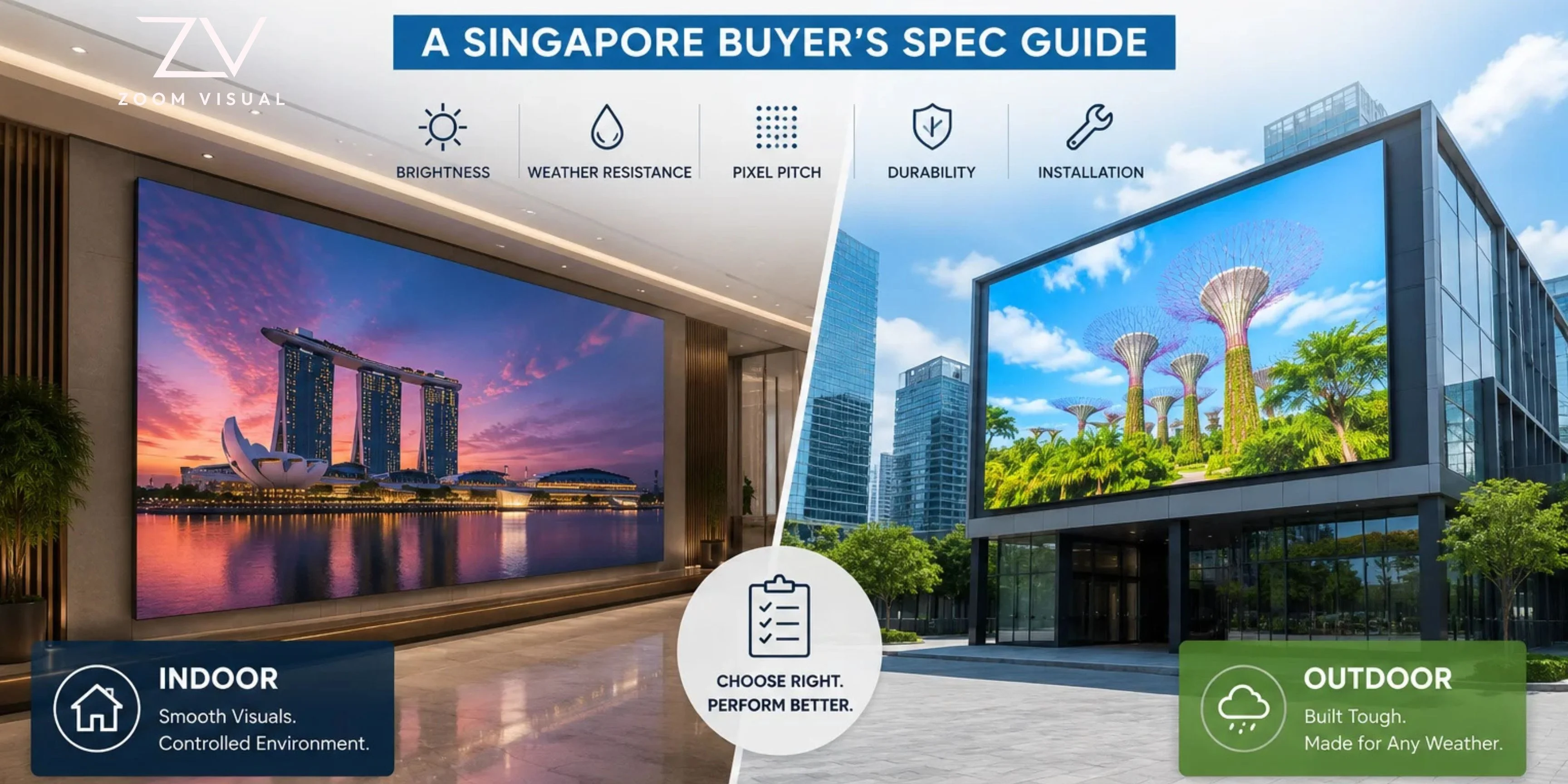
Whether you are designing an executive boardroom in Raffles Place, creating an immersive retail feature wall in Orchard Road, or planning a building-facade billboard in Jurong, choosing between an indoor and an outdoor LED video wall comes down to specific engineering requirements.
While both technologies use modular LED cabinets to build seamless, large-format screens, their underlying hardware, from cabinet sealing to diode driver chips, is engineered for vastly different environments.
Here is a practical specification guide to help Singapore commercial buyers choose the right setup, avoid over-specifying, and maximize return on investment.
1. Brightness Requirements: Fighting Ambient Light vs. Direct Sunlight
Brightness in commercial displays is measured in nits (cd/m²). Getting this spec right is crucial: under-specifying results in a washed-out, illegible screen, while over-specifying wastes capital and power.
| Environment | Recommended Brightness | Primary Consideration |
|---|---|---|
| Indoor Standard (Offices, Boardrooms, Classrooms) | 600 to 1,000 nits | Comfortable viewing without eye strain. |
| Indoor High-Ambient (Atriums, Glass Shopfronts) | 1,200 to 2,500 nits | Direct sunlight exposure through glass facades. |
| Outdoor Standard (Shaded Facades, Covered Venues) | 3,500 to 5,000 nits | High visibility under indirect tropical daylight. |
| Outdoor Full Sunlight (Roadside Billboards, Building Tops) | 5,500 to 8,000+ nits | Overcomes peak equatorial UV and direct overhead sun. |
Pro Tip: For outdoor displays, select a system equipped with automatic brightness sensors. These sensors dim the screen during evening hours, saving electricity while preventing light pollution and driver distraction.
2. Pixel Pitch & Viewing Distance
Pixel pitch (measured in millimeters, e.g., P1.2, P2.5) is the distance from the center of one LED pixel to the center of the next.
- Smaller Pitch: Higher pixel density, sharper image, closer viewing distance.
- Larger Pitch: Lower pixel density, designed for long-distance impact.
Indoor LED Displays(Fine-Pitch Focus)
Because indoor viewers stand anywhere from 1 to 5 meters away, indoor displays prioritize fine pixel pitches:
- P0.9 mm to P1.5 mm (Micro/Mini-LED and COB): Premium corporate boardrooms, broadcast studios, control rooms, and luxury retail where viewers stand right next to the screen.
- P1.8 mm to P2.5 mm: Retail outlets, hotel ballrooms, and event halls where viewing distances are typically 2 to 4 meters.
Outdoor LED Displays (Long-Distance Focus)
Outdoor viewers are typically tens of meters away (for example, pedestrians across a street or motorists at a traffic junction).
- P2.5 mm to P3.9 mm: High-resolution outdoor retail entrances, ground-level walkways, and outdoor staging.
- P4.8 mm to P10.0 mm: Large building facades, elevated billboards, and sports stadiums where viewing distance exceeds 10 to 15 meters.
3. Weatherproofing & IP Ratings: Handling Singapore’s Climate
Singapore’s tropical environment presents two major threats to electronics: torrential rain and relentless heat/humidity.
- Indoor Screens (IP20 to IP30): Indoor cabinets are open-back or ventilated for heat dissipation. They have no liquid ingress protection and rely strictly on ambient building air conditioning.
- Outdoor Screens (IP65 Front / IP54 Rear minimum): Outdoor LED cabinets are hermetically sealed. An IP65 rating ensures the display face is dust-tight and resistant to high-pressure water jets from sudden downpours.
Additionally, quality outdoor LED cabinets utilize anti-corrosion die-cast aluminum alloys and tropicalized conformal coating on internal PCBs to prevent short circuits caused by ambient moisture.
4. Technology Architecture: Surface Mount (SMD) vs. Chip-on-Board (COB) vs. Glue-on-Board (GOB)
How the LEDs are mounted on the circuit board impacts durability and contrast.
SMD (Surface Mount Device)
- Best For: Standard indoor and outdoor displays (P2.5 and above).
- Overview: The traditional, proven workhorse of the industry offering great color uniformity and easy module-level repair.
COB (Chip-on-Board)
- Best For: High-end indoor fine-pitch displays (P0.9 to P1.5).
- Overview: LED chips are mounted directly onto the PCB substrate and encapsulated in a smooth protective resin. This provides superior black levels, ultra-wide viewing angles, and resistance to physical impact or dust.
GOB (Glue-on-Board)
- Best For: High-traffic indoor retail or lower-level outdoor environments.
- Overview: A protective transparent epoxy layer is applied over standard SMD LEDs, adding splash resistance, impact protection, and anti-static defense.
Decision Checklist: Which System Do You Need?
Is your display installation location exposed to rain, direct wind, or unconditioned air?
|
|-- YES --> Outdoor LED Video Wall
|           |-- IP Rating: IP65 Front / IP54 Rear minimum
|           |-- Brightness: 5,000+ nits
|           +-- Pixel Pitch: P2.5 to P8.0 (based on viewing distance)
|
+-- NO ---> Is the screen facing a glass window receiving direct daylight?
            |-- YES --> High-Brightness Indoor LED (1,500 to 2,500 nits)
            +-- NO ---> Standard Indoor LED / COB Display (600 to 1,000 nits)
Transform Your Visual Space with Zoom Visual
From customized indoor curved COB displays to heavy-duty weatherproof outdoor commercial screens, Zoom Visual provides end-to-end site assessment, supply, installation, and after-sales support across Singapore.
Ready to start your display project?
[CONTACT THE ZOOM VISUAL TODAY] to take a look at our showroom and customized quotation tailored to your venue.
Tags:
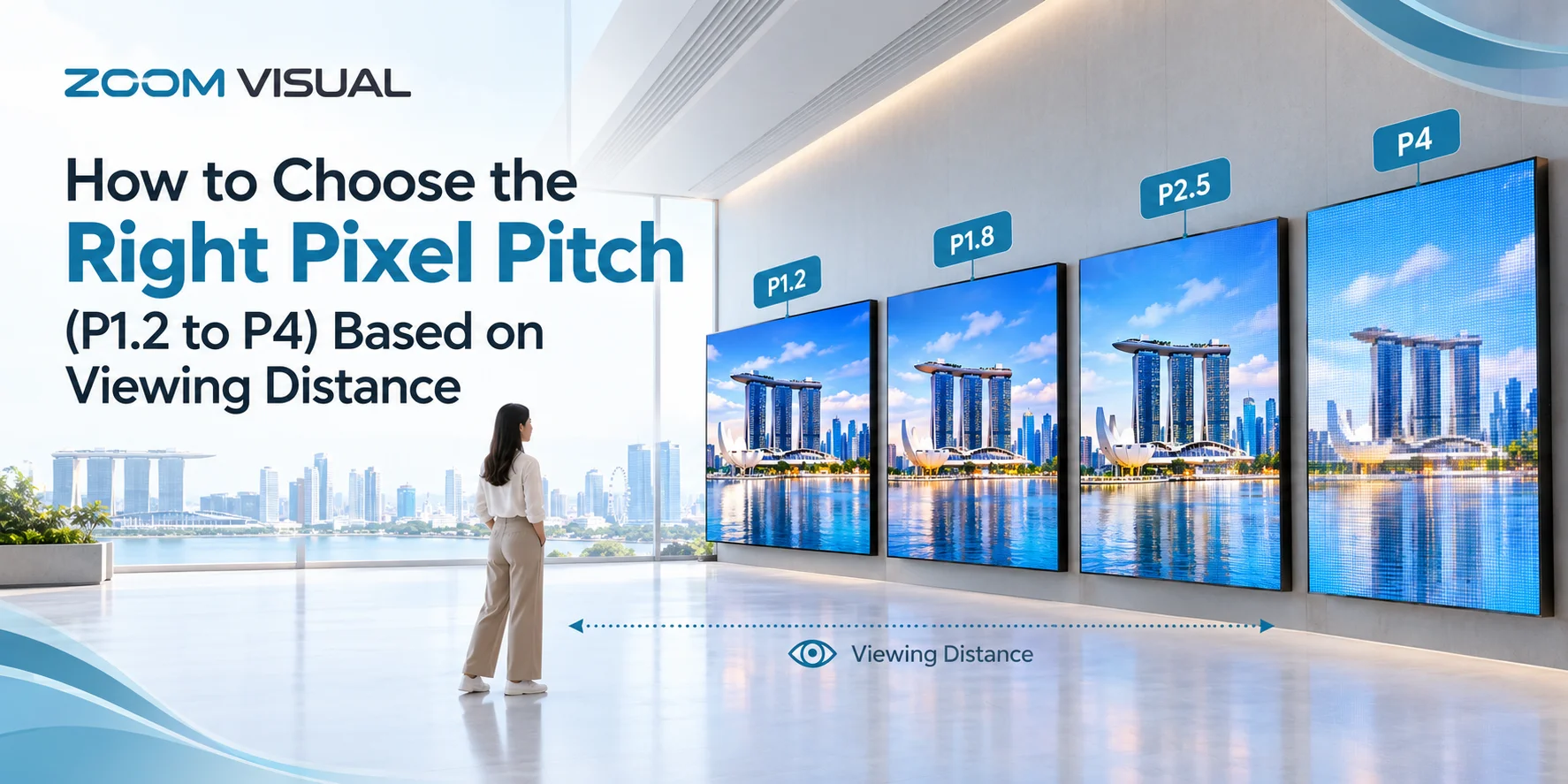
Choosing the right pixel pitch for a commercial LED display is one of the most critical decisions in any AV installation. Whether you are outfitting a high-tech corporate boardroom in Raffles Place or launching a outdoor retail facade on Orchard Road, getting the pixel pitch right ensures crisp image clarity while optimizing your total capital […]
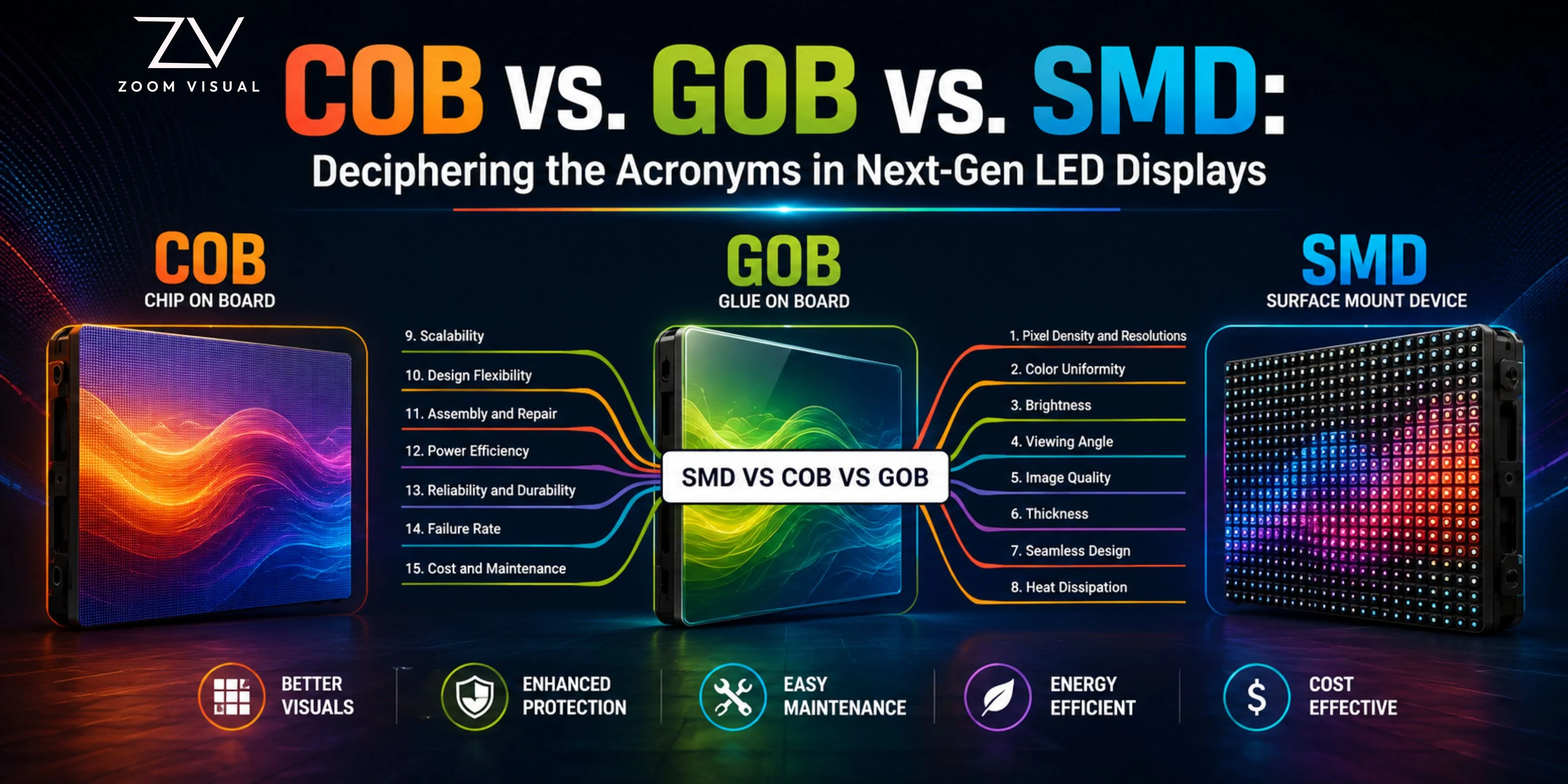
When investing in a commercial LED display in Singapore, whether for a retail outlet on Orchard Road, an executive boardroom in Raffles Place, or a nightlife stage in Clarke Quay, you will quickly run into industry jargon like SMD, GOB, and COB. While all three technologies deliver vibrant visuals, they differ significantly in durability, pixel […]
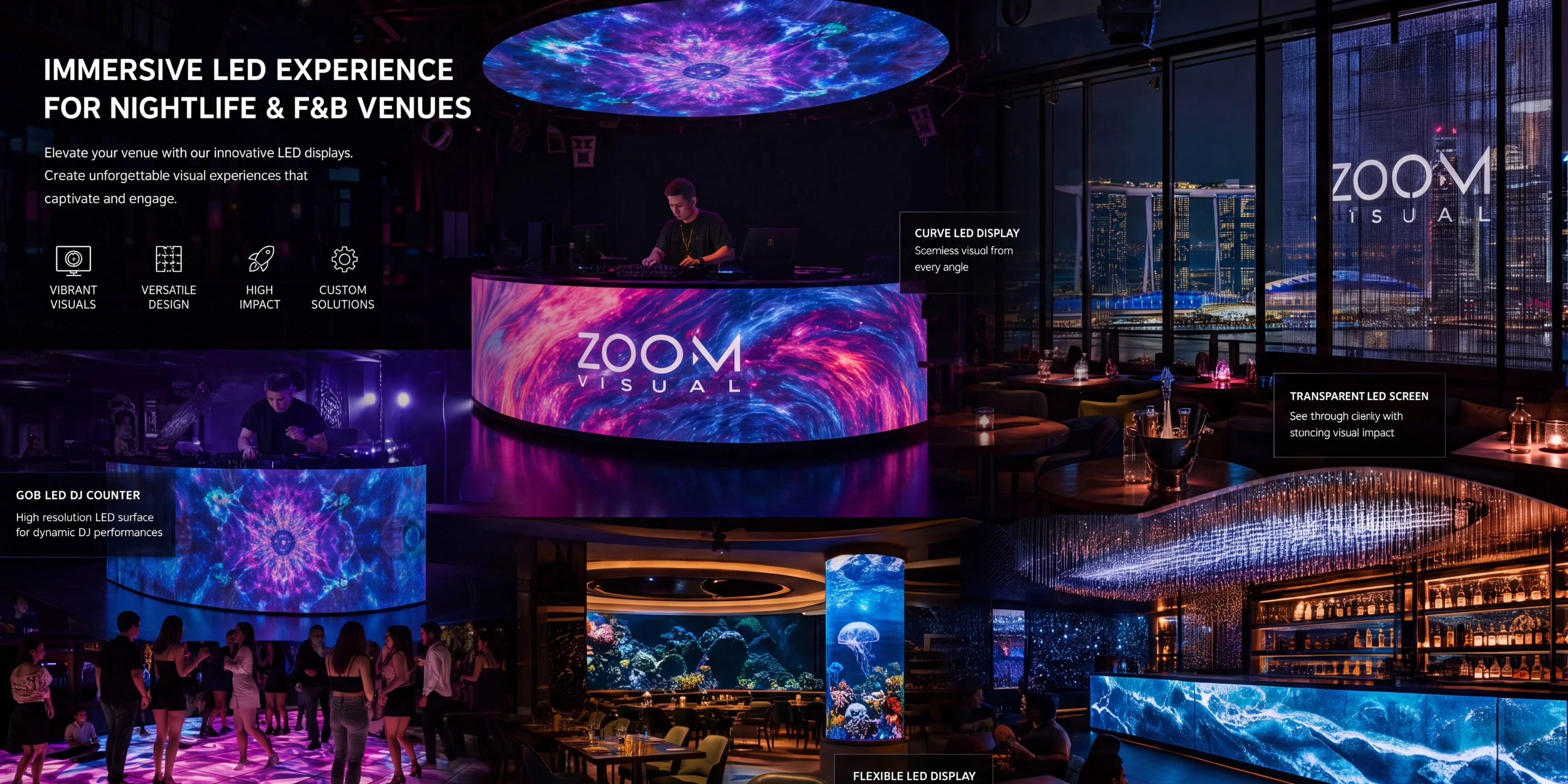
From the bustling, neon-lit alleys of Clarke Quay to the upscale, hidden speakeasies of Tanjong Pagar, Singapore’s nightlife and food & beverage (F&B) scenes are notoriously competitive. With hundreds of venues vying for the attention of locals, expats, and tourists alike, great food and curated drinks are no longer enough to guarantee a packed house. […]
Error: Contact form not found.
Get a quote Now!
Whether you have a question about our services, pricing, or anything else, our team is ready to answer all your questions!